Any time a team begins a new project, there are risky assumptions involved. Precoil Founder David J Bland has learned this all too well through his years of experience helping corporations think more creatively.
In this guide to assumptions mapping, he’ll walk you through an exercise in identifying and mapping assumptions, so you can walk away with actionable next steps so that teams can successfully move their ideas forward.
Be sure to watch the included webinar to watch a hands-on demonstration of assumptions mapping by David J. Bland.
What is assumptions mapping?
Assumptions mapping is an exercise in which a team unpacks any assumptions they may have about a new product or service's feasibility, viability, and desirability. Once outlined, each assumption is prioritized by importance and potential risk.
What are the types of assumptions used in assumptions mapping?
Desirability
Is this something the end-user or customer wants? Is there marketing research or competitive intel that backs up this assumption?
Feasibility
Is this something that the business can manage, scale, and resources? What are the key activities and who are the main partners involved?
Viability
Is this something that should be pursued? What supporting data exists that proves this is a good business decision? What potential risks does this pose?
Why is assumption mapping important?
Product decisions are often driven by assumptions and by mapping them out, teams can better understand which areas need further experimentation or development. Assumptions can be risky if they aren't openly considered, and can even have costly implications if they prove to be unfounded or incorrect. This is why assumptions mapping is such a critical step in product development.
How to get started with Assumptions Mapping
Essentially, the problem lies in the initial intent. When implementing Lean Startup methods, for example, there is room for misinterpretation in the Build, Measure, Learn cycle. He believes that by starting with ‘Build,’ teams and organizations fall into a trap where they are building just to build, instead of building to learn.
To bypass the mechanical mindset, David recommends asking yourself, your team or your stakeholders one question: “What do you want to learn?” In turn, this will shift the approach to beg yet another question: “What assumptions am I making?” And herein lies the key to designing and delivering thoughtful, human-centered, quality products and services.
Before you begin mapping, David also suggests three guidelines worth adhering to:
- Everything you map should be based firmly on what you know today
- Limit yourself to one, single statement per sticky note-- no bullet points
- Have strong opinions, but hold them loosely to make room for new info
Ready to get started?
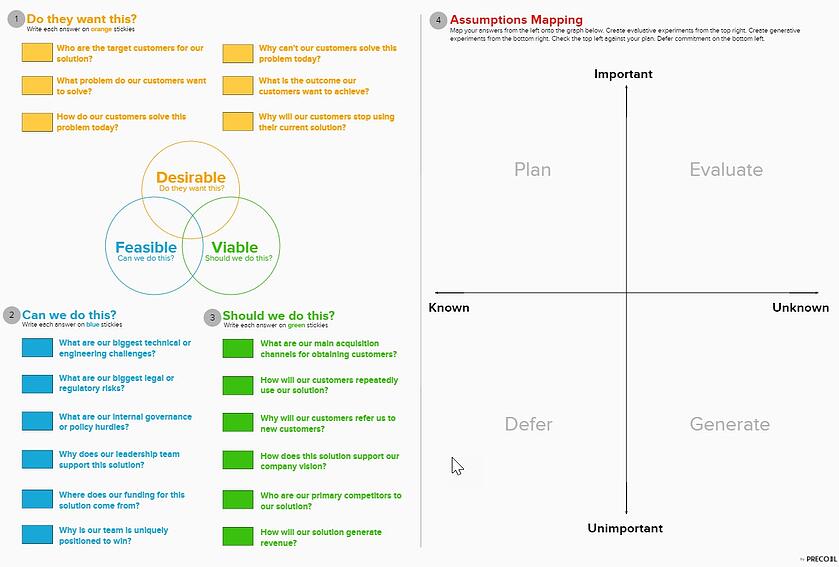
Click the mural below to use David’s Assumptions Mapping template.
How to conduct an assumptions mapping workshop
Step 1: Identify your hypotheses
Add a sticky note and write down each hypothesis you have for product desirability, viability, and feasibility. Your hypothesis should be as specific as possible and be contained within a single sticky note.
Tips:
- Keep your hypothesis short and precise to make prioritization easier.
- To color-code with the template, use orange sticky notes for desirability, blue sticky notes for feasibility, and green sticky notes for viability.
- Collaborate with your team by discussing and agreeing upon the assumptions you add.
Step 2: Prioritize the hypotheses
Use the prioritization matrix to prioritize all your hypotheses in terms of importance and certainty, based on the evidence that supports each assumption.
Step 3: Identify and test the riskiest assumptions
Experiment with the important hypotheses that have less supporting evidence. If these assumptions are proven false, you may need to reevaluate any outcomes based on those hypotheses.
Related: A guide to the design thinking testing stage
Watch the assumptions mapping webinar
David recently joined us for a webinar to explain what Assumptions Mapping is, from a high-level point of view, and why it’s important for individuals, teams and organizations to use when building new products, services or strategies.
Watch the video below to see the full recording.
The bottom line
Whatever step a team is on in the product development phase, mapping out assumptions can help clarify and debunk any misplaced priorities. By mapping out implied rules, teams can speak to any concerns in a dedicated, nonjudgemental environment. This both improves the product end-state and clarifies where teams should focus their efforts.
Related: Learn more about Assumptions Mapping for product teams
Mural is the perfect platform for gaining alignment, mapping assumptions, and unlocking innovation, so you can make the best decisions for your team. Get started today with a free Mural account, and invite unlimited guests and members so everyone has visibility into your assumption mapping process.
Editor's note: An original version of this article was originally published May 22, 2017 and has since been updated.