On this page
Template use cases
Use Statement starters template
Get started
A way to write problem statements that invite broad exploration
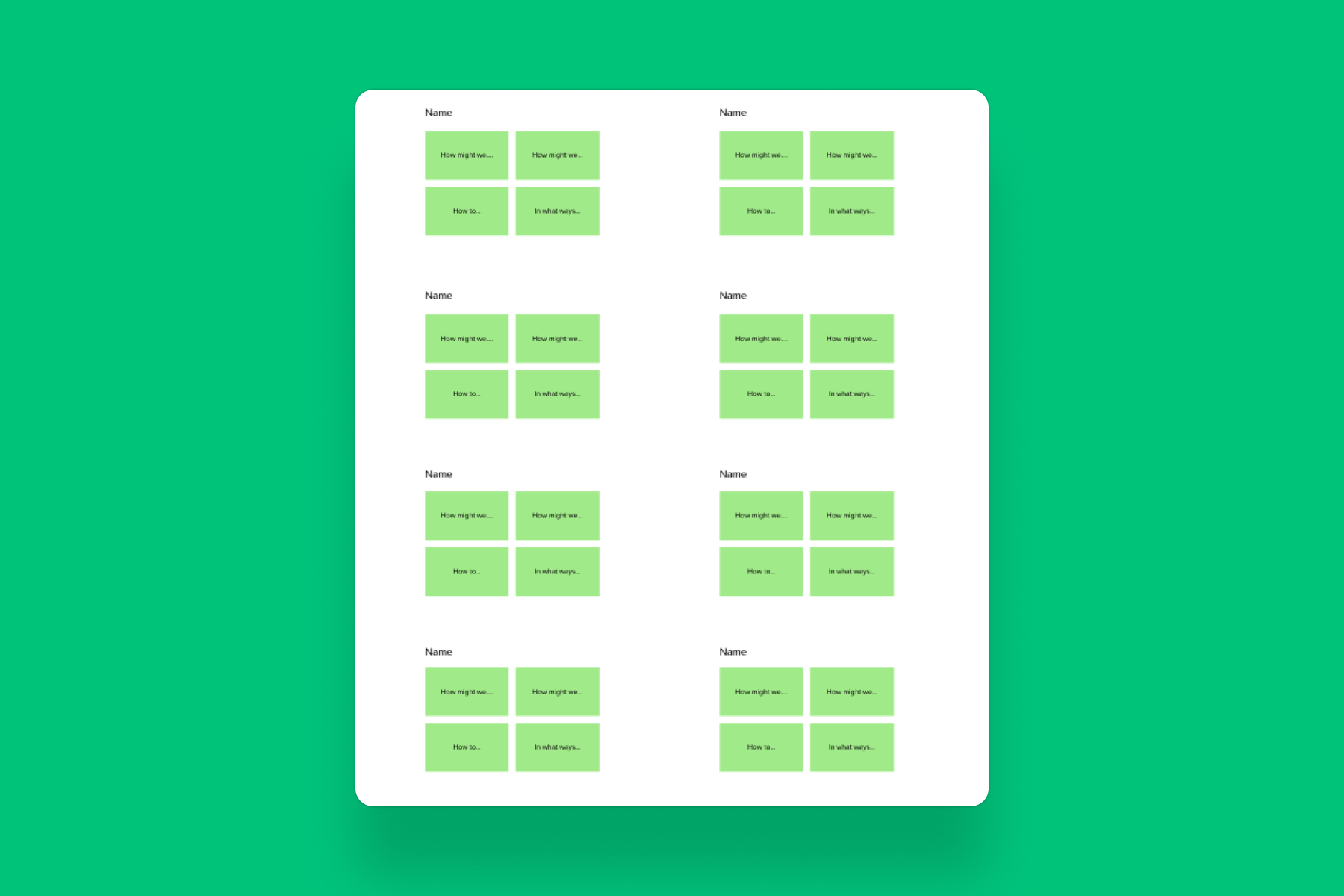
The statement starters template is great for giving your team a structured way to reframe problems into open-ended prompts that invite exploration instead of jumping head-first into solutions. Rooted in problem framing methodology, statement starters are phrases designed to broaden how you think about a challenge. Rather than prescribing a fix, they encourage your team to consider multiple directions before committing to one.
What you end up with is richer discussions, fewer blind spots, and solutions that actually address the root issue. A common example of a statement starter is a “How Might We” question, which turns a challenge into an invitation for creative problem-solving. This template, built on the LUMA System of human-centered design, provides the structure to run this process with any team, on any problem.
A statement starters template is a collaborative workspace that guides teams through the process of rephrasing problems as open-ended prompts. Instead of you or your team accepting a challenge at face value, the method asks you to rewrite it in ways that invite broader thinking.
The concept comes from LUMA Institute’s Statement Starters method, one of 36 human-centered design methods in the LUMA System. It sits within the Understanding category under Problem Framing, alongside techniques like Abstraction Laddering and Problem Tree Analysis. Teams in workshops, design sprints, and strategy sessions use statement starters to make sure they’re solving the right problem before generating solutions.
So let’s look at the difference in practice. A prescriptive statement like “We need a device to help people listen to music” already contains an embedded solution. A statement starter converts that same challenge into something like “How might we help people listen to music?” This tiny shift opens the door to solutions the original framing would have excluded entirely.
Mural’s statement starters template comes pre-built with the structure and prompts you need to move from a raw challenge to a well-framed problem. Here’s what’s included:
Problem framing is the step that determines whether your ideation session produces real results.
Follow these five steps to run a statement starters session with your team. The process works for in-person workshops, remote sessions, and hybrid setups.
Write the challenge your team is facing in one or two sentences. Keep it clear and concise, and avoid embedding a solution in the statement itself. For example, “Our onboarding process takes too long” is better than “We need to build a shorter onboarding video.” The first version leaves room for exploration, while the second has already decided on the answer.
Bring in cross-functional stakeholders who see the problem from different angles. Product managers, designers, customer-facing reps, and engineers will each read the same challenge differently. That diversity is the raw material for strong reframes. Mural’s real-time collaboration makes it easy to include remote participants without losing the energy of the session.
Have each participant rewrite the original challenge as a series of open-ended prompts. The most common format is a “How Might We” question, but other patterns work too: “What if we…”, “In what ways could we…”, or “Imagine a world where…” The goal is to strip out embedded solutions and keep the prompt exploratory.
For example, “We feel burdened by the maintenance of our current products” could become “How might we maintain products without it feeling like a burden?” or “What if product maintenance happened automatically during everyday work?”
Once the team has generated a batch of reframes, compare them. Which ones open up the most interesting territory? Which ones feel too narrow or too broad? Use Mural’s voting and clustering features to surface the strongest prompts and group related reframes by theme.
Take your top reframes and use them as the starting prompts for a brainstorming session. Each statement starter becomes a launchpad for generating ideas. Because the prompts are open-ended, your team will naturally produce a wider range of solutions than if you’d started with a prescriptive problem statement.
Statement starters work best when a problem is complex, ambiguous, or when your team has been stuck cycling through the same ideas. Here are some common scenarios:
In problem framing workshops, dedicate a full session to reframing before any ideation begins. Teams that separate framing from brainstorming consistently produce stronger outcomes.
During early-stage product discovery, statement starters help you avoid committing to a solution before you’ve fully understood the opportunity. When you’re still figuring out what to build, broadening the prompt is more valuable than narrowing the scope too soon.
In innovation and strategy sessions, reframing strategic challenges as invitations for exploration can break your team out of incremental thinking. This is particularly useful for annual planning and OKR workshops where teams default to the same categories year after year.
For UX and customer experience challenges, try converting pain points into design prompts. Instead of “Fix the checkout flow,” reframe it as “How might we make purchasing feel effortless?” The second version opens the door to solutions the first one wouldn’t.
Team alignment sessions benefit from statement starters because when cross-functional teams disagree on priorities, reframing the problem often reveals that different groups are solving for different versions of the same issue.
And for complex or ambiguous problems where you can’t even agree on what the problem is, statement starters force clarity by requiring everyone to articulate the challenge in their own words.
You can also pair statement starters with other LUMA methods. Use Abstraction Laddering to zoom in or out on a problem’s scope before reframing it, or follow up with a Creative Matrix to generate solutions against your strongest prompts.
Getting the most out of the statement starters template comes down to facilitation. Here are practical tips based on how teams actually use this method:
If your starting point is vague, every reframe will be vague too. Spend the first five minutes getting the original challenge down to one or two tight sentences.
Ask each person to generate at least five reframes before the group discusses any of them. Quantity creates the raw material; refinement comes later.
If a reframe still contains a specific solution (“How might we build an app that…”), it’s not open enough. Coach participants to remove embedded answers.
The hardest part of this method is staying in the framing phase. Resist the urge to start ideating until you’ve selected your strongest prompts.
Mural’s Facilitation Superpowers® include private mode, which lets everyone write independently before seeing other people’s reframes. This is especially important for statement starters, where early anchoring can limit the range of perspectives.
After generating reframes, cluster them into themes. You’ll often find that several people reframed the problem in similar ways, which signals a promising direction worth exploring.
Statement starters are one of the most accessible problem framing techniques in the LUMA System, and they pair well with nearly every ideation method that follows. Whether you’re kicking off a design sprint or recalibrating a quarterly strategy, this template gives your team the structure to ask better questions before chasing answers.
Statement starters are phrases or prompts designed to help teams restate a problem in ways that invite broader exploration. Instead of accepting a challenge as given, statement starters ask you to rephrase it as an open-ended prompt, like “How might we…” or “In what ways could we…” This encourages your team to consider multiple directions before settling on a solution. The method is part of LUMA Institute’s system of human-centered design and sits within the Problem Framing category of the LUMA System.
“How Might We” (HMW) is one specific format of a statement starter. Statement starters are the broader method; HMW questions are the most popular pattern within that method. You can also use formats like “What if we…”, “In what ways could we…”, or “Imagine a world where…” Each format reframes a problem slightly differently, and the best workshops often use multiple patterns to generate a wider range of perspectives.
A statement starters template gives your team a repeatable structure for problem framing so you don’t have to reinvent the process every time. The core benefits include: clearer problem definitions before ideation begins, a wider range of solutions because the prompts are open-ended, reduced groupthink when combined with private mode, and faster alignment across cross-functional teams who may interpret the same challenge differently. Teams that invest time in framing consistently report stronger outcomes from the ideation and strategy sessions that follow.